No dumbbells, no bands, no problem. Bodyweight training is one of the most accessible ways to get stronger: it is free, it works anywhere from a lounge room to a hotel room, and almost every exercise can be made easier or harder. This routine covers the whole body in about 20 minutes.
The routine at a glance
- Warm-up: 3 minutes.
- Circuit: 8 exercises, 30 to 45 seconds each with 15 to 30 seconds rest. Two rounds for about 16 minutes.
- Cool-down: 2 to 3 minutes of easy stretching.
Beginners: 30 seconds on, 30 seconds off, one or two rounds. More experienced: 45 on, 15 off, two or three rounds.
Warm-up (3 minutes)
March on the spot for a minute, then do 10 arm circles each way, 10 slow bodyweight squats, 10 hip circles each way and 10 shoulder rolls. You should feel warmer and looser.
The eight moves
1. Squat
Stand with feet about hip-width, toes slightly out. Push your hips back and bend your knees as if sitting into a chair, keeping your chest up and knees in line with your toes. Stand tall and squeeze your glutes.
- Easier: sit down to a chair and stand up.
- Harder: slow three-second lowering, a pause at the bottom, or a small jump.
2. Push-up
Hands slightly wider than shoulders, body in a straight line. Lower your chest towards your hands, then press away.
- Easier: hands on a wall, then a kitchen bench, then a low table, then knees on the floor.
- Harder: full push-ups, or slow lowering.
3. Reverse lunge
Step one foot back and lower until both knees are bent, front knee over the ankle. Push through the front heel to return. Alternate legs.
- Easier: hold a chair, keep the step short and the depth shallow.
- Harder: step back onto a cushion, or pause at the bottom.
4. Glute bridge
Lie on your back, knees bent, feet flat. Press through your heels and lift your hips until your body forms a line from shoulders to knees. Squeeze, then lower slowly.
- Harder: single-leg bridges, or feet on a step.
5. Bird dog
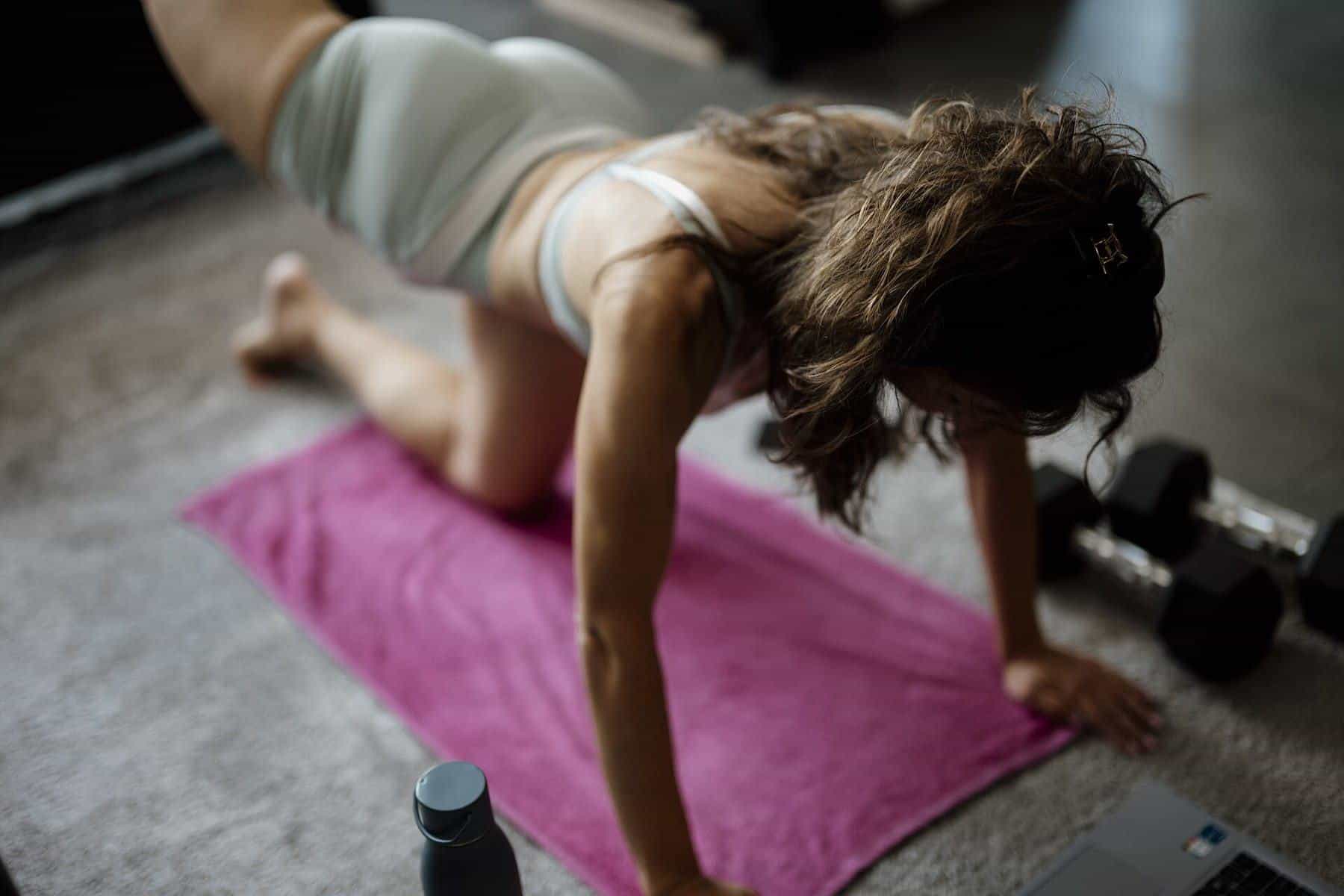
On all fours, hands under shoulders, knees under hips. Reach one arm forward and the opposite leg back, keeping your back still and hips level. Return and swap.
6. Step-ups or marching
Step up onto the bottom stair, bring the other foot up, step down. Alternate the leading leg. Hold the rail. Or march on the spot with high knees.
7. Plank
Forearms on the floor, elbows under shoulders, body in a straight line. Breathe steadily.
- Easier: knees down, or hands on a bench.
- Harder: lift one foot, or reach one arm forward.
8. Side-lying leg lift and clam
Lie on your side, knees bent. Keep your feet together and open your top knee like a clamshell, then straighten the top leg and lift and lower it. Swap sides halfway through.
Cool-down (2 to 3 minutes)
Slow your breathing. Stretch your thighs, hamstrings, hips, chest and shoulders, holding each stretch for about 20 to 30 seconds without bouncing.
Form reminders
0 of 6 done
Ticks are saved in this browser only.
How to progress
Once you can complete two rounds with good form and it feels comfortable:
- Add 5 to 10 seconds of work per exercise.
- Cut 5 seconds of rest.
- Add a round.
- Move to the next harder variation.
- Slow down: a three-second lowering phase makes almost any move harder.
A four-week plan
| Week | Work / rest | Rounds | Sessions |
|---|---|---|---|
| 1 | 30 / 30 seconds | 1–2 | 2 |
| 2 | 30 / 30 seconds | 2 | 2–3 |
| 3 | 40 / 20 seconds | 2 | 3 |
| 4 | 40 / 20 seconds | 2–3 | 3 |
Add walking on other days to cover the aerobic part of the guidelines.
When to add equipment
Bodyweight training can take you a long way. When the harder versions start to feel easy, a resistance band or a pair of dumbbells adds new challenge. See resistance band workouts and dumbbells at home.
Safety
If you have a health condition, joint problems, an injury or are pregnant, check with your doctor or physiotherapist which moves suit you. Stop if you feel sharp pain, chest pain, dizziness or unusual breathlessness.
Doing it anywhere
Because it needs no gear, this routine travels well. Do it in a hotel room, at a park, or in the backyard. On holidays, one or two rounds keep you ticking over without eating into your plans. See our active holidays guide.
Turning it into a 10-minute version
Short on time? Pick four of the eight moves, one each from legs, push, core and heart rate, and do two rounds of 40 seconds on and 20 seconds off. It is a quick way to keep the habit going on busy days. See our 10-minute workouts for more ready-made circuits.
Frequently asked questions
How long should I rest between rounds?
Rest for one to two minutes between rounds, or until your breathing settles enough to start again with good form.
Can I do this workout if I have bad knees?
Many people can with modifications, such as shallower squats and lunges and holding a chair for support. Check with a physiotherapist if you have ongoing knee pain.
Can bodyweight exercises build strength?
Yes. Bodyweight exercises can build strength, especially for beginners. Progress by choosing harder variations, adding repetitions or slowing the movement down.
How often should I do a bodyweight workout?
Two or three times a week on non-consecutive days works well for most people, alongside walking or other aerobic activity.
What if I cannot do a push-up?
Start with wall push-ups, then progress to a bench or table, then knees on the floor, then full push-ups. Everyone starts somewhere.
Are burpees necessary?
No. Burpees are one way to raise your heart rate, but marching, step-ups and squats to a calf raise do the job with less impact.
How do I know my form is right?
Move slowly, use a mirror or film yourself, and follow the cues in this guide. If something hurts, stop. A session with a qualified trainer or physiotherapist can help.
Is it OK to do this workout barefoot?
On a mat, many floor exercises are fine barefoot. Wear supportive shoes for stepping or jumping moves.
Sources and further reading
Facts on this page were checked against these primary and official sources. Conditions change — confirm before you travel or buy.
- Physical activity and exercise guidelines for all Australians — Australian Government Department of Health
- Exercise safety — Better Health Channel (Victorian Government)
- Physical activity — World Health Organization