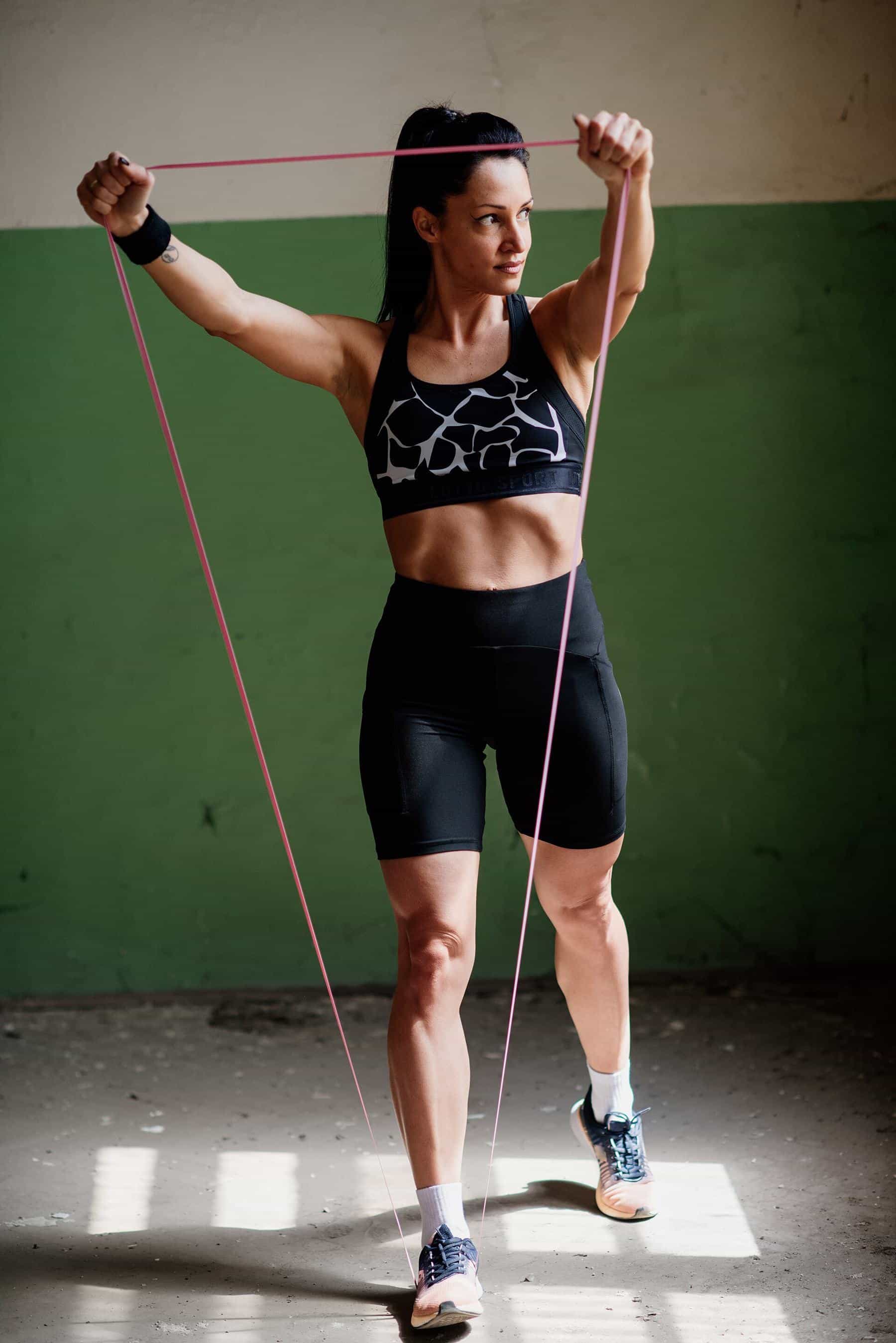
If you want to add resistance to home workouts without filling your lounge room with gear, start with a resistance band. Bands are cheap, light and compact, and they let you train pushing, pulling, squatting and hinging movements, which are the building blocks of strength. They are also perfect for travel.
Types of band
| Type | Looks like | Good for |
|---|---|---|
| Long loop band | A large, flat loop of latex | Rows, presses, squats, assisted pull-ups |
| Tube band with handles | A rubber tube with handles at each end | Presses, rows, curls; often with a door anchor |
| Mini loop band | A small, wide loop | Glute and hip work around the thighs or ankles |
| Flat therapy band | A long, flat strip with no handles | Light rehab and mobility work |
| Fabric booty band | A small, wide fabric loop | Glute work; less likely to roll up |
Bands are usually colour-coded by resistance, but colours are not standard between brands, so check the labelled resistance.
Choosing your first band
A good starter kit is a set of two or three long loop or tube bands (light, medium, heavy) plus a mini loop band. Look for clear resistance labels and a door anchor if you choose tubes. If you have a latex allergy, choose latex-free or fabric bands.
Safety basics
- Inspect before every use. Look for nicks, tears, thinning or sticky patches. Replace damaged bands.
- Anchor securely. Use a proper door anchor on a solid door, closed on the hinge side, or loop the band under your feet. Never anchor to furniture that can tip.
- Control the return. Do not let the band snap back.
- Protect your face. Keep the band below face height where possible, and do not point it at others.
- Store properly. Keep bands away from sunlight, heat and sharp objects.
The full-body band circuit
Do each exercise for 10 to 15 controlled repetitions, rest 30 to 60 seconds, then move on. Complete two or three rounds. Choose a band that makes the last two or three reps challenging with good form.
- Banded squat. Stand on a long loop band with feet hip-width, holding the top of the band at your shoulders. Squat down and stand up.
- Seated or standing row. Sit with legs out and the band around your feet, or anchor it at chest height. Pull the handles towards your ribs, squeezing your shoulder blades together.
- Banded glute bridge. Mini band just above your knees. Bridge up, pressing your knees slightly outwards against the band.
- Chest press. Anchor behind you at chest height, or wrap the band around your upper back. Press forward, then return slowly.
- Lateral walk. Mini band around your thighs or ankles. In a slight squat, step sideways 10 steps each way.
- Overhead press. Stand on the band, hands at your shoulders. Press up overhead, then lower slowly.
- Pull-apart. Hold a light band in front of your chest with straight arms. Pull it apart by squeezing your shoulder blades, then return.
- Pallof press. Anchor the band at chest height to your side. Hold it at your chest and press straight out, resisting the twist, then return. Swap sides.
Band workout checklist
0 of 7 done
Ticks are saved in this browser only.
How to progress
- More tension: step further from the anchor, or shorten the band.
- Heavier band: move up a resistance level.
- Double up: use two bands together.
- Slow down: a three-second return phase increases the challenge.
- More reps or rounds.
A weekly plan
Combine two or three band sessions a week with walking or other aerobic activity. On busy days, do one round of the circuit, or mix band moves into our 10-minute workouts.
Bands for warm-ups and mobility
Light bands are also great for warming up before any workout: pull-aparts and gentle rows wake up the upper back, and lateral walks prepare the hips. Physiotherapists often use light bands for rehabilitation exercises; if you are recovering from an injury, follow their specific advice.
Bands versus dumbbells
| Bands | Dumbbells | |
|---|---|---|
| Cost | Low | Low to moderate |
| Space | Tiny | Small to moderate |
| Travel | Excellent | Poor |
| Resistance | Increases as band stretches | Constant |
| Durability | Wear out over time | Last for years |
Many people end up with both. See dumbbells at home.
Common mistakes
- Band too heavy: form suffers and joints take the strain. Go lighter.
- Letting it snap back: you lose half the benefit and risk injury.
- Poor anchoring: a band slipping off a door handle can hit you.
- Ignoring wear: small nicks can turn into a snap.
Band workouts for travel
Bands are the perfect travel companion. Roll one or two into your suitcase and you can do a full-body session in a hotel room in 20 minutes. Use the bed frame or your own feet as anchors rather than hotel furniture, and check the band carefully after packing in case it has been nicked. On a long trip, two or three short band sessions a week, plus plenty of walking while you explore, keeps you ticking over nicely.
Frequently asked questions
What resistance band should a beginner buy?
A set of long loop bands or tube bands in light to medium resistance is versatile, plus a mini loop band for glute work. Sets with several resistance levels let you progress.
Are resistance bands as good as weights?
Bands can build strength effectively, especially for beginners and for home training. They load muscles differently from weights, with resistance increasing as the band stretches.
How do I anchor a band at home?
Use a door anchor designed for bands, closed on the hinge side of a solid door, or loop the band around your feet or a sturdy post. Never anchor to something that could move or break.
How long do resistance bands last?
It depends on use and care. Check bands regularly for nicks, tears or thinning and replace them if damaged. Store them out of direct sunlight.
Can bands snap?
They can if damaged or overstretched. Inspect before each use, avoid sharp edges and do not stretch bands beyond the manufacturer's guidance.
Are bands good for travel?
Yes. They are light and compact, ideal for hotel-room workouts.
Sources and further reading
Facts on this page were checked against these primary and official sources. Conditions change — confirm before you travel or buy.
- Physical activity and exercise guidelines for all Australians — Australian Government Department of Health
- Exercise safety — Better Health Channel (Victorian Government)